Restore the Original Editions

Śrīla Prabhupāda departed in 1977. Every change to his books since is unauthorised.

What happened

Between 1972 and 1977 Śrīla Prabhupāda published his translations and commentaries. They sold in the millions, were praised by scholars, and were the books he saw, corrected and approved.

After his departure in 1977 they were revised. The revisions were not announced, no list of the changes was published, and the new editions appeared under the same title, the same cover and the same author's name.

The extent of the alterations — thousands of them — became public only decades later, through comparisons made by devotees rather than by the publisher.

Signatories

have signed.

Loading the register…

Every signature carries the same weight; the groups exist so that the register can be read, not ranked. Signatures are confirmed by email before they appear and duplicates are rejected by address. Entries among the initiated disciples are reviewed by hand, and the year and place of initiation are published beside the name so the list can be checked by those who were there.

Read the full text of the demand ↓

The demand

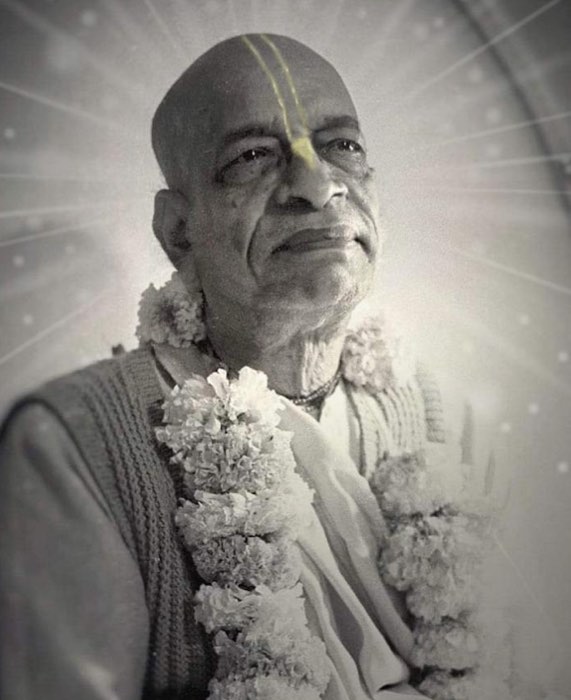
A. C. Bhaktivedanta Swami Prabhupāda
His Divine Grace A. C. Bhaktivedanta Swami Prabhupāda, 1896–1977.

To the directors of the Bhaktivedanta Book Trust International.

An author who has departed cannot approve a revision. Śrīla Prabhupāda departed in 1977; every change to his books since was made by someone else, without the author's authorisation.

As the ones who hold the authority at this time, we hereby call upon you to restore the original 1972–1977 editions as the standard texts published, translated and distributed worldwide, and to give any revised edition a distinct cover, the editor's name on it, and a published record of every change — as the Modern Language Association requires of any edited text of a primary source.

The undersigned

The text of the demand above was sealed on and cannot be changed — how that is proved. · This is the text that is signed; the Spanish version is a reference translation, sealed separately.

How this was circulated

The disciples were asked first.

The demand was written and sealed before anyone was asked to sign it. It was then sent first to the disciples initiated by Śrīla Prabhupāda who have publicly campaigned for the restoration of his books — before it was shown to anyone else, and before this page was announced anywhere.

That order was deliberate. They knew him. They know what the books were. The request belongs to them before it belongs to the rest of us.

From there it opened outward in stages: to the devotees who distribute and defend the original books, then to their own circles, and only at the end was this page announced publicly. Each stage is dated in the records below.

Who was invited to sign

Invited Written to Status Reply Proof
The first invitations go out when the petitioners' consultation closes. This table is published empty, before anything is sent, so that nothing can be added to it retroactively without the record showing it.

Who received the demand

Director Notified Status Answer Proof
Delivery takes place on the announced date, with every signature received up to that date included in the document delivered.

Questions

Nothing here asks to be taken on trust.

Who wrote this, and on what criteria?

It was drafted and agreed among the petitioners before publication, and has not changed since it was sealed. Four rules governed the drafting.

Only what cannot be disputed. No quotation whose meaning is contested, no claim about anyone's intentions, no assertion of fact that is not a matter of record. The premise is a date.

Addressed only to those who can act. Not to the past, not to an institution in general, but to the people who hold the authority to do this today.

As short as possible. A long document invites negotiation and dilution. This one asks for two things.

Nothing punitive. No person is accused, no removal is sought, no edition is to be destroyed.

Can I sign without my name being published?

No, and it is worth saying plainly why.

A number of anonymous supporters proves nothing. It cannot be checked, it can be dismissed as invented, and it gives the directors an easy reason not to answer. What obliges an answer is the opposite: identifiable people, whose connection to the mission can be verified by anyone who knows them, willing to put their names to a single sentence.

Your name and your connection to the mission are published; your city and country only if you give them; your email address never.

We know this costs something for devotees serving inside temples. It is the reason the demand asks for nothing beyond the restoration itself, and names no one but its addressees — so that signing it is as defensible a thing to have done as it can be.

What happens to my email address?

Signing sends a single-use link to the address you give, and the signature does not count until you open it. That is what stops anyone adding your name without your knowledge, and what stops the list being inflated with names that do not exist.

Your address is used for that confirmation, and to tell you what answer the directors give. Nothing else. It is never published, never shared and never passed to anyone. There are no cookies, no analytics and no third-party scripts on this site.

How can I check that nothing here has been altered?

Before a single signature was collected, the exact text was published and its fingerprint recorded on a public, permanent record. If one word had been altered — by us or by anyone else — the check below would fail.

Canonical text
letter-en.txt
SHA-256
3e8818711246be7c15c49c5d57f6c20c0af9a46c3e47add2e8e7ed952f4216c9
OpenTimestamps receipt
letter-en.txt.ots — anchored in Bitcoin
Reference translation
letter-es.txt, sealed separately
curl -O https://restore.vedicvault.org/letter/letter-en.txt
curl -O https://restore.vedicvault.org/letter/letter-en.txt.ots
sha256sum letter-en.txt
ots verify letter-en.txt.ots

The register of signatures is deliberately not sealed this way. Permanence must protect a text; it must never trap a person. It is available as JSON at /api/register.

Each recipient of the demand receives an individually addressed email — never a bulk mailing, never a blind copy list — certified by an independent service, with the original .eml and its DKIM signature retained and linked from the record.

What this does not claim. These records establish that a document existed in a specific form on a specific date, that it was addressed to a named person through a channel they use, and whether a reply arrived by the stated deadline. They do not, and cannot, prove that a recipient read it. We say so here rather than let it be discovered as an objection.

Does this interfere with the court case in Delhi?

No, and the text was drafted so that it could not.

The demand makes no allegation of wrongdoing against any person. It asserts no fact that is in dispute in any proceeding. It takes no position on the parties, the evidence or the merits of any case. It claims no legal right and seeks no remedy from any court. It is a request addressed to the directors of a corporation, asking them to do something that lies within their own authority.

Its single premise is a date — the author departed in 1977 — which no party anywhere disputes.

If counsel to any party nonetheless believes otherwise, we ask them to write to us and say so. We will publish their statement in full and unedited, and we will act on it.

Does this divide the movement?

The demand asks for one thing that every party to this discussion already says it wants: Śrīla Prabhupāda's own words, available as he gave them. Nothing in it concerns any person, office or institution, and it names no one but its addressees. If agreement on that single point divides us, the division was already there.

Are you asking anyone to reject or destroy the revised edition?

No. The demand asks that the original editions be the standard, and that any revision stand separately and be clearly identified as a revision. That is the ordinary practice of publishing, and it costs the revised edition nothing but its anonymity.